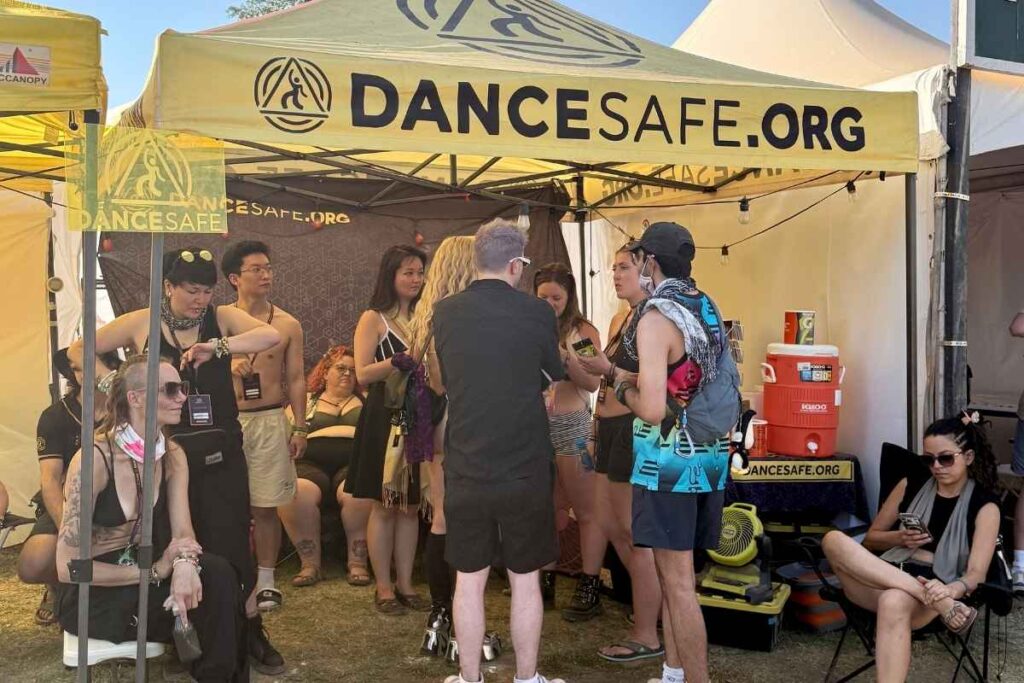
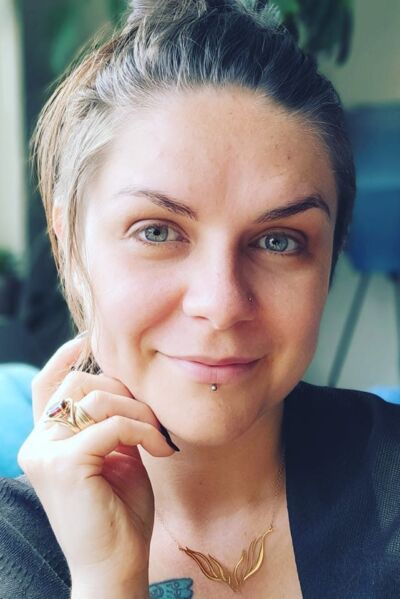
DanceSafe Executive Director Mikayla Hellwitch shares her perspectives on harm reduction, drug policy and more
If there's one thing that's undeniable about raves and festivals, it's that people use drugs at them, and that drug use comes with inherent risks as well as potential rewards. For some, drugs enhance the experience, while for others, they provide a way to escape or to fuel an addiction. Regardless of the intents behind drug use, one of the biggest risks is simply not knowing what you're actually taking.
In the fentanyl era, that uncertainty has never been more fatal. Fentanyl has fundamentally changed the landscape of recreational drug use, because a lethal dose is roughly two milligrams, or about the size of 5 to 7 grains of salt. Dealers cut it into other substances because it's cheap and potent, but when users don't know what they're getting, it creates the perfect conditions for a potentially lethal overdose.
That's why testing your substances is now more critical than ever, but even drug checking has its limits. For example, if fentanyl is unevenly distributed throughout a pressed pill or powder sold as MDMA, you could test one portion of your supply and get a clean result, while the portion you consume is impure. Which is exactly why harm reduction is about more than just one tool or technique, but about building a culture of awareness.
Education is the first step of harm reduction. Knowing your limits and understanding risks is the foundation. From there, it's about the choices you make in the moment, like drinking enough water, looking out for your friends and the people around you, and avoiding mixing substances or even choosing to rave sober. Those small decisions can make the difference between an enjoyable night of raving and a difficult experience or overdose.
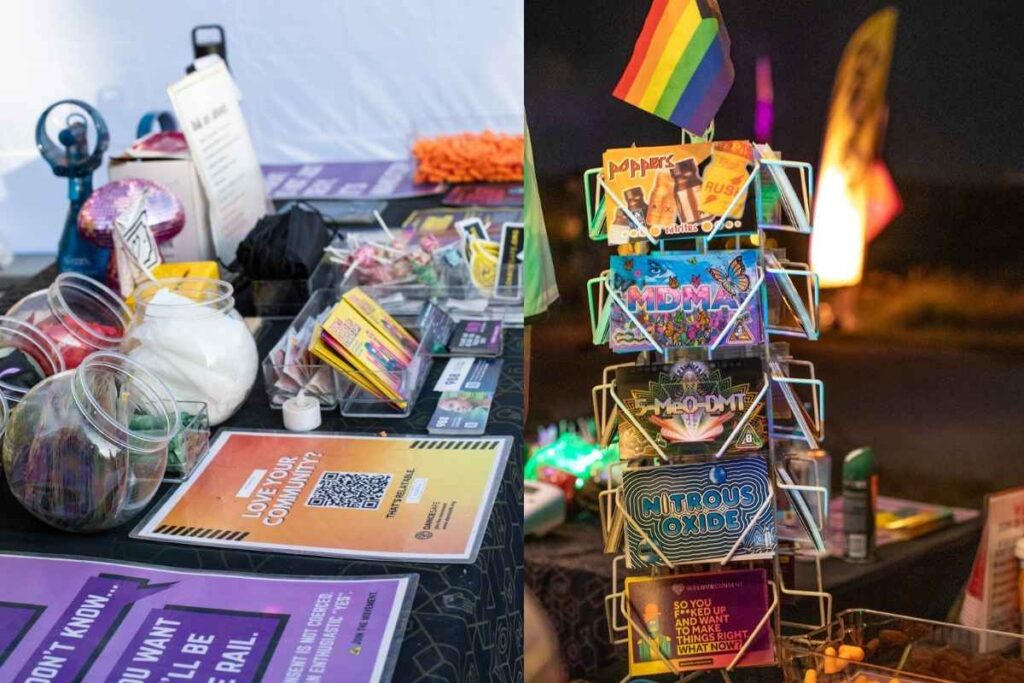
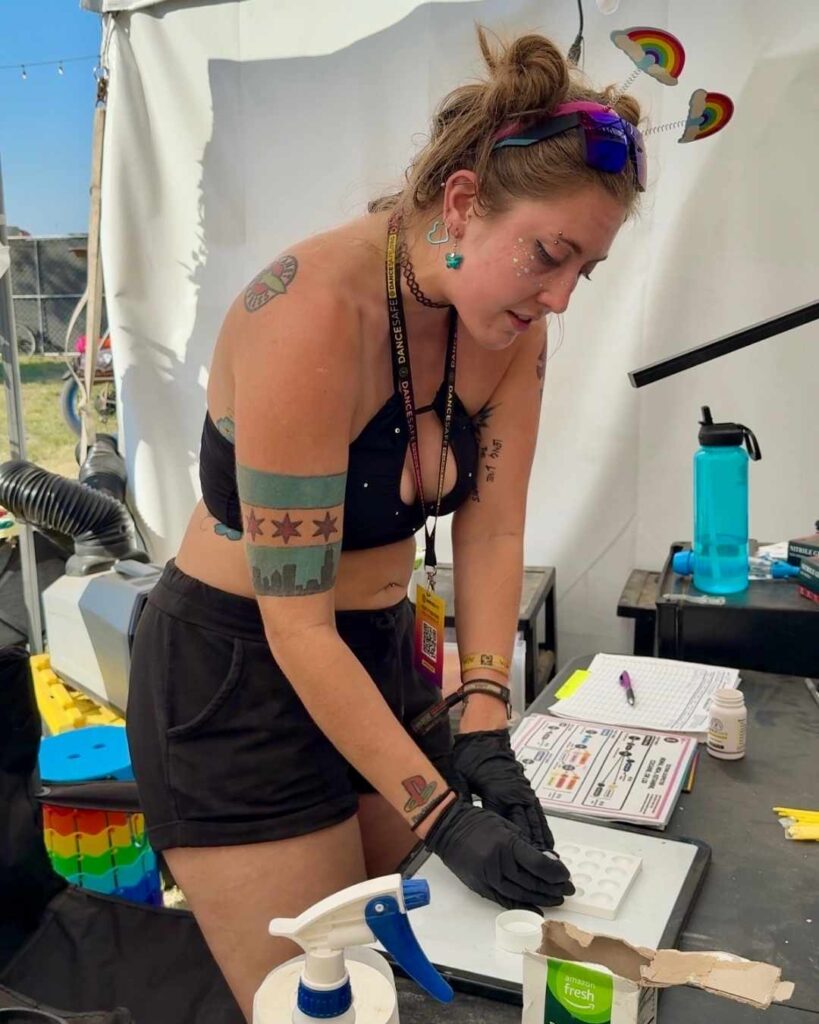
That's where organizations like DanceSafe come in. Founded in 1998, DanceSafe is a nonprofit public health organization that has been embedded in the electronic music community for almost three decades, operating on a simple but radical premise: people are going to use drugs, and they deserve accurate information and resources to do so as safely as possible. From festival booths stocked with reagent test kits to educational outreach on everything from consent to hearing protection, DanceSafe meets ravers exactly where they are, without judgment.
We sat down with DanceSafe Executive Director Mikayla Hellwitch to talk about harm reduction, drug stigma, collective responsibility, and what the festival community can do to make events safer.
Electric Feels
How has DanceSafe, harm reduction and drug culture in the festival and rave scenes shifted over the years?
Mikayla
What I've seen from DanceSafe over the years is a lot of growth and expansion throughout the electronic music scene, and being able to offer more, like being in more places and also having a lot more to offer. So now we're offering fentanyl test strips and offering more different kinds of reagents, and offering earplugs and offering education around safer sex and consent.
I've also noticed a shift in which substances are being used. It seems like ketamine has been really big for the last handful of years. With that, of course, the popularity of a substance also lends itself to additional risk, and different kinds of cutting agents. For example, MSG was being used as a cutting agent for ketamine and other substances, because most people can't tell the difference by looking at it.
Electric Feels
How can festivals adapt to the need for harm reduction, and what are the challenges that come with that?
Mikayla
A lot of the challenges associated with that has to do with old drug war stigma and this perception that offering these services is somehow condoning drug use. One of the principles of harm reduction is that we are neither condemning nor condoning drug use, but accept that drug use is a reality and move forward from that reality-based perspective that, yes, there is going to be drug use going on, no matter how hard we try to control it.
How can we make sure that people have access to the information and resources that they need to make the safest possible choices for themselves? And often that just requires having honest conversations.
A woman named Didi Goldsmith went on a campaign a number of years ago, or began this campaign after her daughter died at a venue in Washington D.C. After taking MDMA, she died of heat exhaustion and dehydration. Instead of doing what many parents do in a situation where they go to their local politicians and demand that drugs be more heavily punished, she went on a quest to amend the RAVE Act so that venues and event promoters would feel more inclined to provide even basic support, like free water at events.
She was able to get the Department of Justice to write a public letter affirming that the RAVE Act does not prohibit events from providing educational materials and support for that. A lot of event promoters aren't aware that that protection exists.
Electric Feels
Do you think it is the event promoter's responsibility to provide these resources?
Mikayla
Yeah, I think that there is a public health imperative. In general, if you are providing a space where people gather, that comes with certain obligations. What are they legally obligated to do? What are they obligated to do in a humanistic sense, or a person-centered sense?
Are they trying to create a positive experience for people where they can connect with their friends, to connect with the music, and really have a meaningful moment? Then that means providing access to support and services that people in those spaces are looking for.
At the same time, venues and event producers are bound by regulations that are still more focused on punishment than public health. They can only be as involved in the health of their patrons as the law allows them to be without putting themselves at risk. At its core, this is a policy problem. In that sense we have a collective responsibility to advocate for laws that let people make the safer choices they want to make
There's a saying in harm reduction of meeting people where they are. If you want to provide the service, or if people are going to have access to the things that we want them to have access to, then we have to go to where those people are. Well, where are people using drugs? One of those places is at live music events, but it's not just in the rave scene either.
Electric Feels
In Portugal, harm reduction has taken hold in the government by changing the law in terms of reducing drug penalties, but also safe use and providing recovery resources for addicts. How can we learn from this in the U.S.A.?
Mikayla
OnPoint NYC is one example of a supervised use space in the U.S. These types of harm reduction programs are in many places, including Portugal, and they offer sterile syringe programs and space for people to use. On top of that, they're able to reverse overdoses instantly, and people don't die in those facilities because of that. The evidence in favor of them doing so is very strong.
Programs like these are life-saving, and the people who access these services are significantly more likely to enter treatment and use more harm reduction practices on their own. So then why are we not doing this on a larger scale here in the USA?
A lot of it has to do with stigma, but there's also a provision in one of the earlier iterations of the Controlled Substances Act. And this statute is colloquially known as the crack house statute (21 U.S. Code § 856), and it makes it a federal crime to knowingly maintain drug-involved premises.
It was never intended to block the life-saving services that we're talking about, though. Yet the Crackhouse Statute has been repeatedly cited in court battles over these exact harm reduction programs in the United States. The statute keeps turning into this blockade. Basically, if a judge decides that they don't want to support the program, then they can point to that law and say, well, here we go. We can't do it.
Electric Feels
Event organizers can only do so much in terms of harm reduction. What should individual responsibility look like?
Mikayla
There's a balancing act between individual responsibility and collective responsibility. We have to be accountable. But what about the relationship between individual choice and the context in which we make it? For many people who use drugs, they've decided the risks are worth it -- that doesn't mean they deserve to be harmed.
We don't want to shame people for their ignorance, for an accident, for making a bad or unhealthy choice, for making a choice that can impact other people, like taking too many drugs at once or accidentally, or getting too high and getting overwhelmed. We don't want to shame people for that, but also, there is a shared experience and a shared responsibility of knowing your limits and watching out for your friends.
It's important to have rally points, to have good communication between you and your squad, so that people aren't getting lost when they're overwhelmed and then feeling alone. I think there is some individual responsibility, but also very much a shared responsibility of making sure that new people who come into these spaces, especially young people, are aware that they're they might be offered drugs, and there is a lot of risk associated with that alone. There's a risk associated with taking substances in general, and then there's these other risks involved with taking substances with or from someone you don't know.
Electric Feels
Is it the responsibility of folks to use drug checking kits and to carry noxalone or something similar?
Mikayla
I wouldn't say that it's everyone's responsibility to do that, because some people just don't have access to resources. But I would say that it's very important that, if you do have access to those things, then, yes, please use them.
We are ideally accountable for the choices we make and what comes after. But we don't make decisions in a vacuum. The government also has a responsibility to make the conditions we live in safer. Regulating the drug supply would help ensure that when people do make choices about what to consume, many of the risks (i.e. contamination with other drugs, imprecise dosing, purchasing from unknown suppliers) have already been prevented.
It's a lot easier to stay alive if you know the drugs are pure, accurately measured, and reliably sourced. We ran the experiment to see if telling people to not use drugs would create a drug free society. Is 55 years of prohibition enough time to prove the experiment failed? Or are we just going to keep watching people get hurt and blame the drugs?
Electric Feels
Is there anything else you'd like to say to the rave and festival community?
Mikayla
I think I could punctuate the conversation by saying that providing better care to people who are gathering at events is an expression of love. We do this because we love people. Whether it's a friend, a stranger, DanceSafe or another organization, let's step up and provide what we can for whatever people need.
We are in a very challenging, very confusing time that thrives off of our separation and our confusion. Whatever we can do to take care of people and to help people to feel safe is valuable. Help people make good choices for themselves, and help people stay connected to one another, stay connected to their their hope and their vision for the future. I think that's all super, super important.
To learn more about harm reduction and what you can do to help, check out DANCESAFE.ORG.